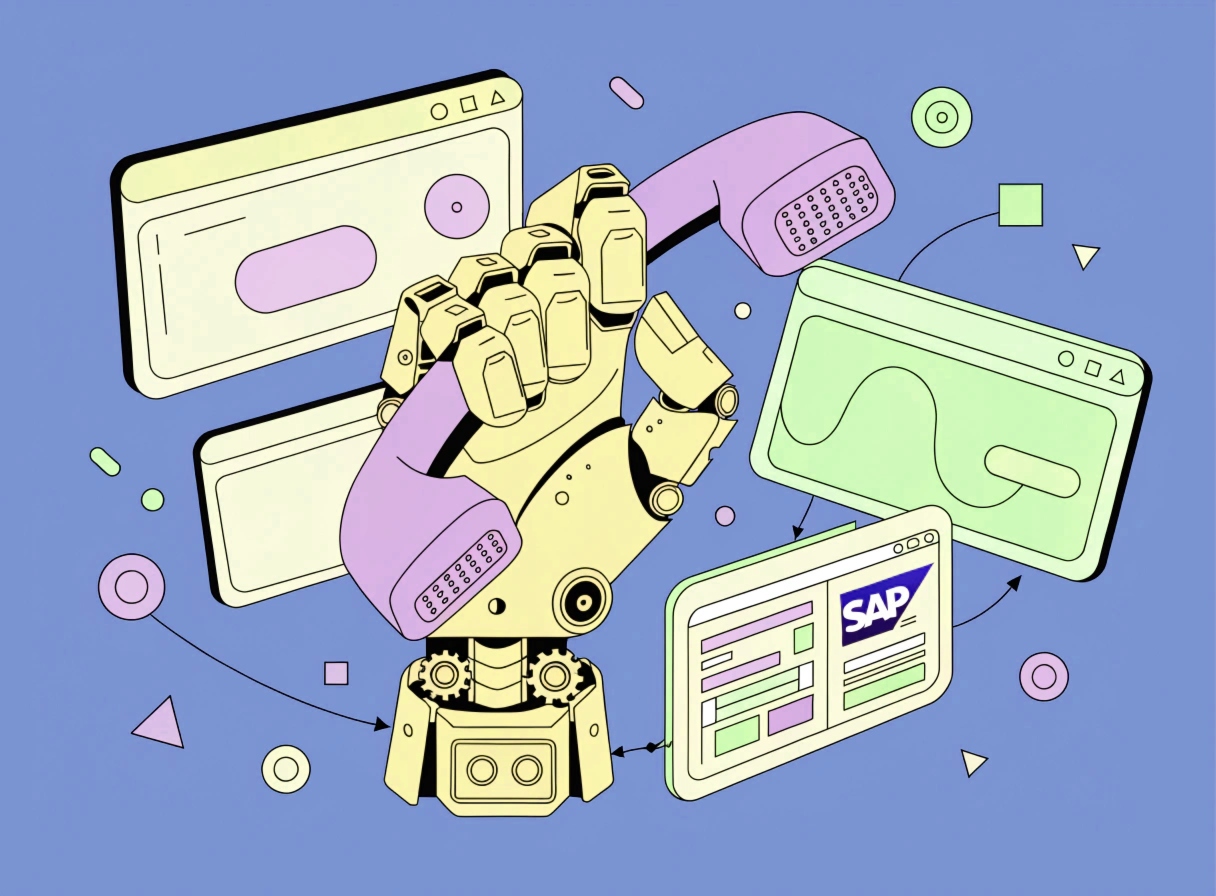
For a decade, "automation" meant a bot that did one narrow thing on one specific screen and fell over the moment anything changed. The new generation is different in a way that's easy to under-sell: it doesn't need the screen to hold still.
An AI agent can read a messy email, log into an ERP it has never seen a fixed layout for, reconcile a document, update a record — and, when the process genuinely needs a human conversation, place a phone call in natural language, follow a governed script, capture the outcome and write it back. The unit of automation stopped being "a click" and became "a task."
That shift is why analysts who spent years watching RPA disappoint are suddenly forecasting a step-change.
The forecast, with the caveat included
That last number matters as much as the first three. This is not a "buy everything with 'agent' in the name" moment. Gartner expects a large fraction of agentic projects to be killed off by 2027 for the usual reasons — unclear value, runaway cost, weak risk controls — and reckons only around 130 of the thousands of self-described agentic vendors are the real thing. Gartner even has a name for the rest: "agent washing," the rebranding of ordinary RPA and chatbots with agentic marketing. [1]
So the trajectory is real and the hype is real. Both can be true — and 2026 is the year the two finally sit side by side and get checked against each other.
The forecasts didn't move; what changed is that there's now a real number to check them against. "40% of apps will have this by 2026" and "17% of organizations actually deployed it in 2026" are different measures — one counts software, one counts companies — but the gap between intent and reality is exactly where the caution belongs.
What actually changed under the hood
The difference between a bot and an agent is the difference between a script and judgment.
This is what lets an agent survive contact with real operations. The old promise was "we'll automate the process." The honest new promise is narrower and more useful: we'll handle the exception end-to-end, and only interrupt a human when judgment or a relationship really matters.
One of the more thoughtful framings of where this goes came from a European retail founder writing about the future of work:
AI does the repetitive digital and phone work end-to-end. Humans focus on decisions, creativity, customers and partners.
Tomáš Čupr, founder of Rohlik, on the future of operations workThat's the part the "robots taking jobs" panic misses. The goal isn't fewer people. It's a different mix of what people do — less copy-paste, more of the judgment they were actually hired for.
Governance is the feature, not the paperwork
Here's the thing that separates a demo from something you'd let near a live, money-moving process: control.
An agent that can log into SAP and call your suppliers is powerful and, ungoverned, terrifying. So the credible versions of this technology lead with the boring stuff — and the boring stuff is the moat. Gartner's own 2026 Hype Cycle backs this up directly: governance, security and cost-management ("FinOps for agentic AI") have each emerged as distinct tracked categories this year — evidence that oversight concerns are rising in step with adoption, not trailing behind it. [3]
What "enterprise-grade" has to mean here: rules, thresholds and approval points defined before the agent runs, not discovered after. High-risk, irreversible or commercial actions pause for a human. Every action leaves proof — timestamp, rationale, review trail. And it's IT-aligned by design: central governance, controlled access, full audit trails — not shadow IT running on someone's laptop.
The reason this matters commercially: business users want speed, IT wants control, and for a decade those two wanted incompatible things. Every serious automation idea hit the same wall — scarce engineering capacity, long integration roadmaps — and died waiting for a slot. Agents that run on the systems you already have, with governance built in, are the first credible answer to "can we automate this without a six-month integration project?" that doesn't require IT to choose between speed and control.
My Take, Your Summary
What to do with this if you run operations
Don't buy the hype, and don't dismiss it. Do three things instead.
- Pick one exception-heavy, high-volume process — the kind that quietly eats your team's week.
- Insist that any tool starts by showing you how that process actually runs before it automates anything.
- And make governance a hard requirement on day one, not a phase two.
The winners of this cycle won't be whoever deployed the most agents. They'll be whoever pointed a well-governed agent at the right messy process — and gave their people the week back.
I'm Ramar Ranjeet Skanda — I build products and write about operations and AI from Prague. If you're piloting agents in a real operation (not a demo), I'd genuinely like to compare notes.

Comments
0Be the first to comment.