
A chatbot answers. An agent acts. That one-word difference is the whole story of 2026.
Anthropic's working definition is the cleanest one going: an agent is an "LLM autonomously using tools in a loop" [1]. It takes a goal, decides which tool to call (search a database, send an email, run code), looks at the result, and decides what to do next — over and over until the job is done or it gives up. A chatbot needs you in the loop. An agent runs the loop itself.
That's the "what." The "how can you use it to your benefit" is where the money is — and the data says most companies haven't found it yet.
Adoption is wide. Scaling is rare.
McKinsey's State of AI 2025 surveyed 1,993 leaders across 105 countries. Nearly 88% say their organization regularly uses AI somewhere. But agents specifically? 62% are experimenting, only 23% have scaled them in even one function [2].
The gap between 62% and 23% is the entire opportunity. Experimenting is free and proves nothing. Scaling is where the return lives — and most of your competitors are stuck on the wrong side of that line.
The market is voting with its wallet
Analysts rarely agree, but here they roughly do: the AI-agent market is growing ~41–46% a year and lands somewhere north of $50B by 2030.
Take the exact figure with salt — these are vendor forecasts, not gospel. But three independent firms landing on a ~45% CAGR is a signal, not noise [5][6].
What the ROI actually looks like
Numbers beat adjectives, so here are two real ones.
Klarna's customer-service agent handled 2.3 million conversations in its first month — two-thirds of all chats, the equivalent workload of 700 full-time agents. Resolution time dropped from 11 minutes to under 2, repeat inquiries fell 25%, and Klarna pegged the 2024 profit impact at ~$40M [7][8].
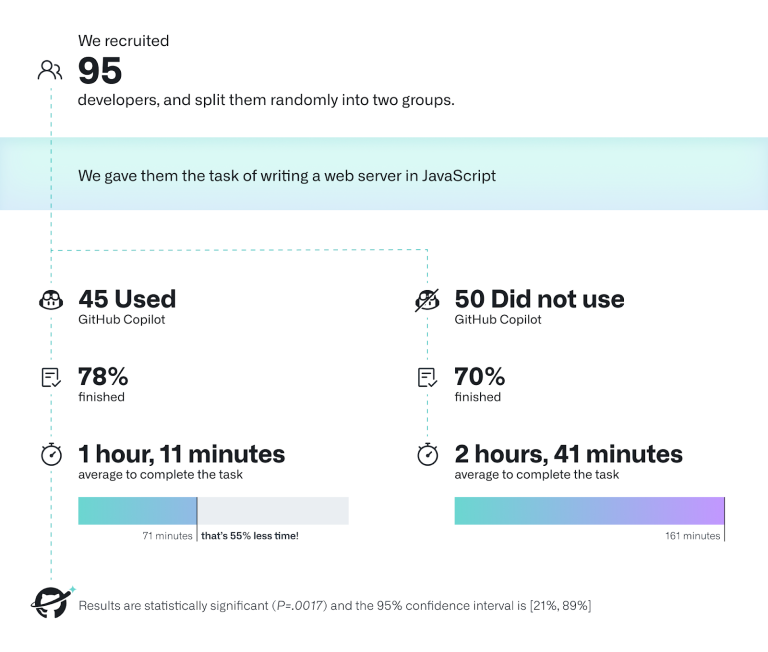
GitHub Copilot, in a controlled study, let developers finish a coding task 55.8% faster (1h11m vs 2h41m) with a higher completion rate (78% vs 70%, statistically significant).
The 23% do one thing differently
McKinsey's most useful finding isn't a number about agents — it's about you. The single strongest predictor of real financial impact is workflow redesign. High performers are 3.6× more likely to pursue enterprise-level change, and 55% of them fundamentally redesign workflows when they deploy AI, versus roughly 20% of everyone else [2].
Translation for builders: bolting an agent onto a broken process gives you a faster broken process. The 23% who scaled didn't automate the old workflow — they rebuilt the workflow around what an agent is good at.
My Take, Your Summary
How to be in the 23%
Three moves, in order:
- Pick one narrow, measurable, high-volume workflow. Not "transform support" — "draft first-response replies to refund requests." You want a job with a number attached so you can prove ROI in weeks, not quarters.
- Redesign the workflow, don't wrap it. Decide what the agent owns end-to-end and where a human signs off. Klarna's win came from giving the agent the whole resolution loop, not a suggestion box.
- Instrument before you scale. Resolution rate, time saved, escalation rate, cost per task. If you can't measure it, you can't defend it to finance — and undefended agent projects are the ones that get cut.
The honest caveat. Klarna later walked back its AI-only stance and re-hired humans for complex cases, with its CEO conceding that pure cost-cutting produced "lower quality" service. The lesson isn't "agents don't work." It's that the ROI is real and the failure modes are real — design for both from day one.
The next post in this series is entirely about that gap.
The agent era isn't coming; 62% of companies are already in it. The question is whether you'll be experimenting next year or scaling. The 23% started narrow, measured everything, and redesigned the work. That's the whole playbook.
Next in this series: Hype vs reality — An AI agent is a model that uses tools in a loop. The tech works. The pilots mostly don't — 95% deliver no measurable ROI. The reason isn't the model.

Comments
0Be the first to comment.