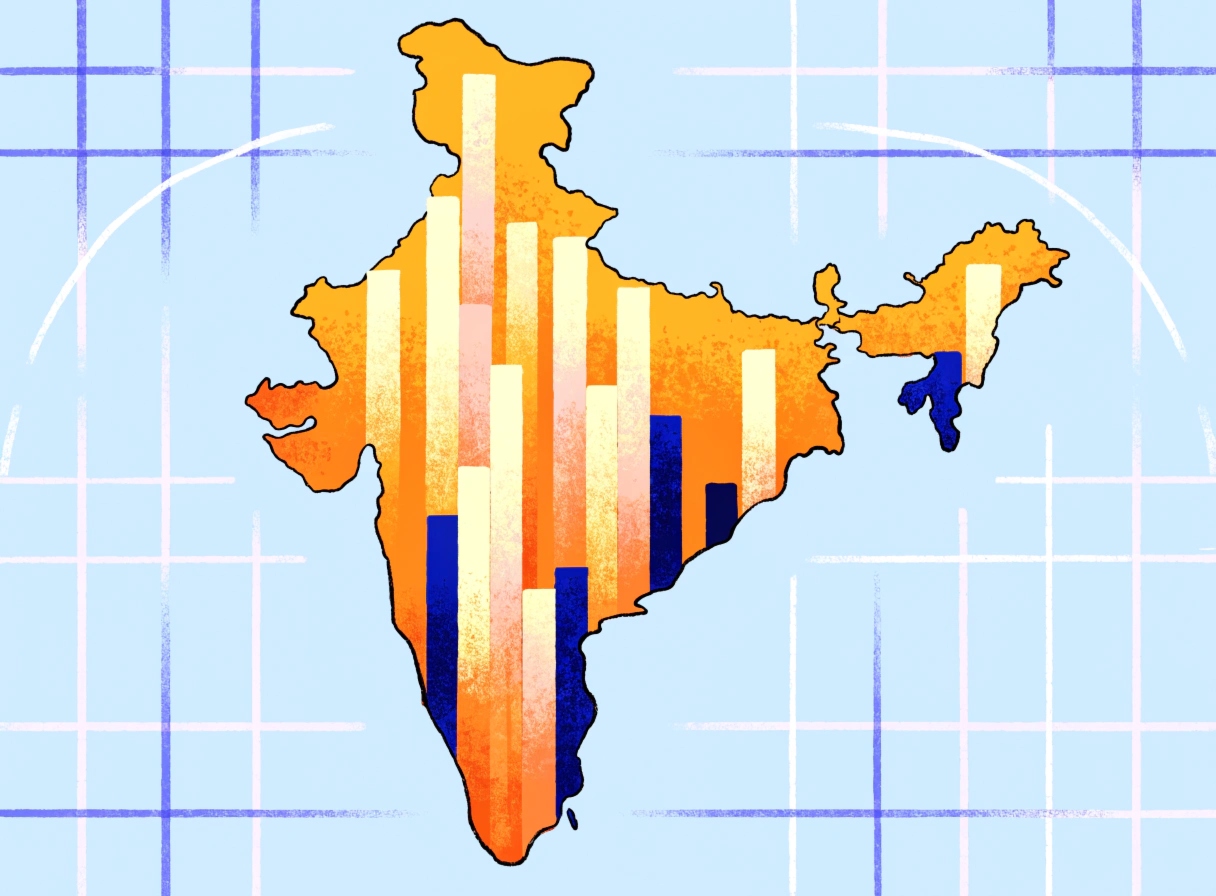
Most Western software companies think about India the way they think about a long-haul flight: someday, maybe, when there's a reason. The numbers say the reason already arrived.
India's retail and consumer economy was worth $1.06 trillion in 2024 and is projected to reach $1.93 trillion by 2030 — a 10% compound growth rate that adds nearly a whole United Kingdom's worth of retail in six years. [1] That alone would make it interesting. What makes it strategically interesting is a second number most people miss.
The number that changes the calculus
Read that against the usual worry — "we're a European company, we won't understand the local market." India's enterprises are, right now, spending the majority of their software budget on products built in San Francisco, Tel Aviv and, yes, Europe. A platform built in Prague is not walking in at a disadvantage. It's walking into a market that already prefers to buy global.
Where the growth actually concentrates
The headline market is huge but fragmented. The part that matters for enterprise software is where retail consolidates — onto modern trade, e-commerce and the ERPs that run them.
E-commerce roughly doubles its share of Indian retail — from about 7% to 14% by 2030 — and more than 60% of those transactions now originate in tier II and III cities, not the metros. [1] This is the digitising, systematising layer of Indian retail: the one that runs on SAP, generates structured transactions, and creates exactly the kind of repetitive, high-volume operational work that software can take over.
Definitions matter here. "Organised retail" is measured differently across reports — some count only e-commerce, others include modern trade. The cleanest sourced figures are the Deloitte–FICCI ones used above (total market, and the $75B→$260B online trajectory). Treat broader "organised retail share" claims as directional, and anchor on the online and total-market numbers, which are consistently reported.
Why thin margins make this an operations story, not a growth story
Here's the part that connects a macro TAM to a concrete product wedge. Indian organised grocery runs on some of the thinnest margins in world retail — an everyday-low-price model where the entire game is taking cost out of operations without breaking them. DMart (Avenue Supermarts) built a ₹57,790 crore (~$6.9B) business precisely by being ruthless on operating cost. [3] Reliance Retail, at ~$39.6B, competes on the same axis at a vastly larger scale. [4]
When margins are that thin, the CFO's question isn't "how do we grow?" — it's "how do we run this operation for less without losing control?" That is the exact question operations-automation answers. And it's why the most interesting European reference point isn't a tech giant but a grocery operator: Rohlik, the European online-grocery unicorn, has become a proving ground for AI-driven operations for the same reason — grocery is the most cost-punishing, exception-heavy environment there is. If it works there, it works anywhere.
My Take, Your Summary
India isn't a market you enter for the logo. It's a market where a huge, fast-growing, margin-squeezed retail sector is consolidating onto the exact enterprise systems that operations-AI already speaks to — and where buyers have already voted, with 65% of their wallet, that they'll buy the best software regardless of where it was built.
The prize is a trillion-dollar retail economy running on software it mostly imports. The question for any serious operations-AI company isn't whether India matters. It's who moves first.
Next in this series: why a single Indian retailer represents an order-of-magnitude more "agent surface area" than a European one — and why the integration wedge already fits.
I'm Ramar Ranjeet Skanda — I write about product, operations and AI from Prague, with one eye on the market I came from.


Comments
0Be the first to comment.