
If you only read headlines, the product job market is a graveyard: layoffs, "AI is coming for PMs," hiring freezes. If you only read the data, it's a recovery: openings at a three-year high and climbing. Both are true at once, and the gap between them explains why so many good PMs are quietly miserable in their job search.
Let's start with the genuinely good news.
The recovery is real
Lenny's Newsletter, using hiring data from TrueUp (which tracks 9,000+ tech companies), counted over 7,300 open PM roles globally in early 2026 — 75% above the low of early 2023, up nearly 20% in the first months of 2026 alone, and the most open PM roles since 2022. [1] Engineering told the same story: 67,000+ openings worldwide. This is not a market in collapse.
There's even a structural tailwind for PMs specifically: the ratio of PM to designer demand has flipped since 2023 and keeps widening (PMs are now wanted 1.27× as often as designers). [1] As AI lets small teams move faster, companies seem to want more people who decide what to build and fewer who polish how it looks. Make of that what you will.
So where's the pain coming from?
The catch is in the distribution. More openings doesn't mean more people landing jobs — and the recovery is concentrated in exactly the places that don't help someone breaking in.
As Lenny put it bluntly:
More openings doesn't automatically mean people are finding jobs more quickly.
Lenny Rachitsky, on the early-2026 dataThree squeezes are happening under the healthy headline number:
The bottom rung is missing. The growth is in senior and AI-specific roles, not entry points. Companies are hiring fewer trainee PMs, product analysts, and product owners — the on-ramps. One hiring-trends report found startups cut junior product roles by more than half year-over-year while expanding senior ones. [3] If you're trying to become a PM, the recovery is happening one floor above you.
The top is glutted. At the Head of Product, VP, and CPO level, there are far more qualified candidates than chairs. Plenty of experienced leaders are resetting expectations — and titles — downward.
The map redrew itself. Remote PM openings keep declining while the Bay Area's share keeps rising — now 23% of all open PM roles, up 50% since 2022. [1] For anyone outside a hub (I am an India based Founder and Product Manager currently living in Prague), the headline number overstates what's actually reachable from your kitchen table.
Pay: stable, not booming
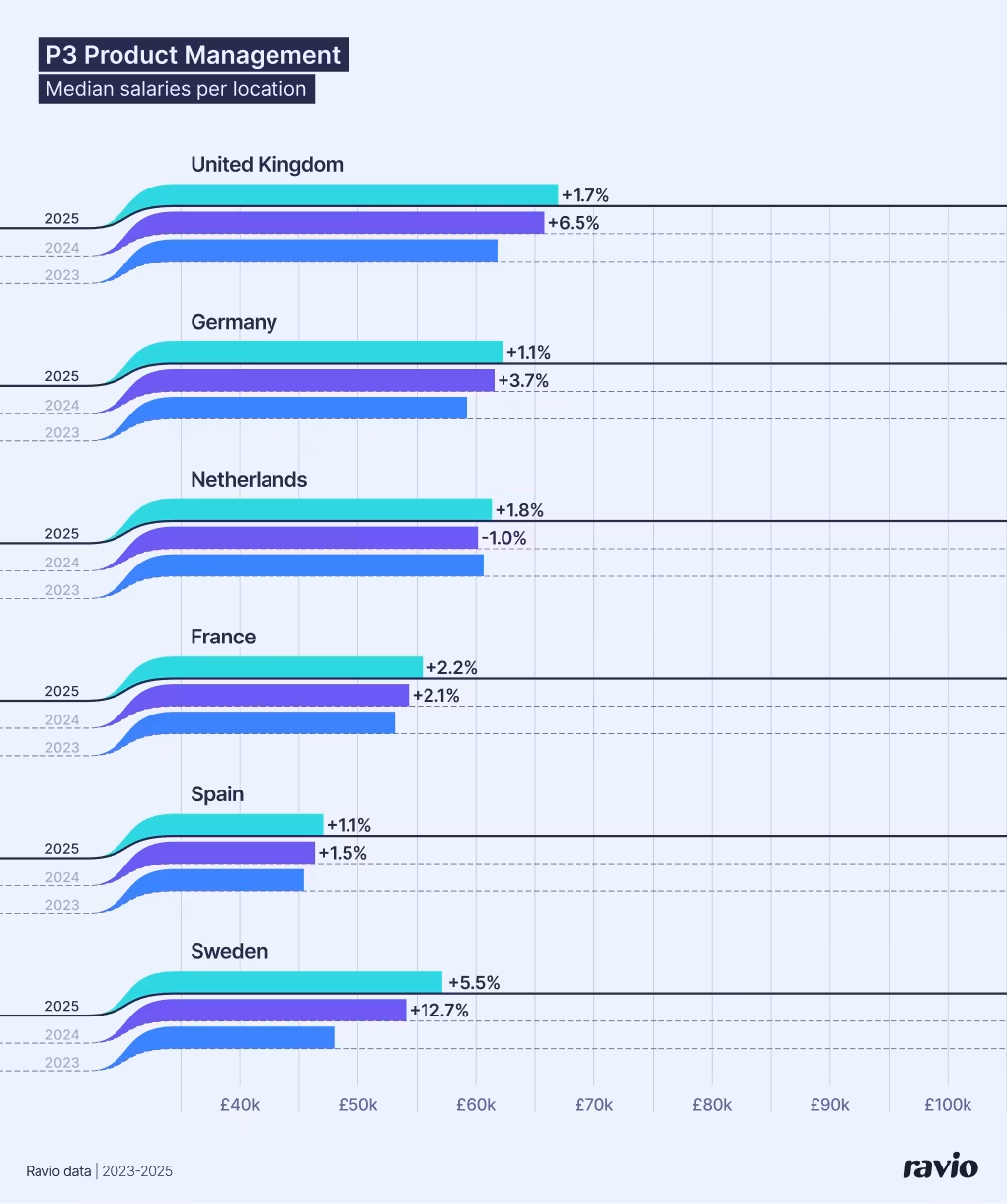
The compensation picture is the quietest part of the story — and quiet is good news after a few brutal years. Across Europe, median PM salaries grew modestly in 2025: roughly 1–2% in most markets, with Sweden the standout at +5.5%. [2] Mind the Product's read was that entry and mid-level pay stayed essentially flat while senior IC roles (Senior PM, Group PM, Principal PM) rose as companies paid up for proven execution. [4]
My Take - Your Summary
The market will pay a premium for someone who has already shipped, and very little extra for potential. That's the same senior-skew showing up in openings, now in the paycheck.
How to read all this: the macro number (openings up 75%) and the lived experience (it's hard out there) aren't contradictory — they're describing different rungs of the same ladder. If you're senior and have shipped, it's a decent market. If you're trying to get in, or you're a leader without a seat, it's a knife fight. Aim your strategy at the rung you're actually on.
The honest summary: 2026 is the best PM job market in three years and still a hard one to break into. The recovery is real. It's just standing on a ladder with its bottom rungs sawn off.
Final post in this series: the elephant in every standup — how AI is actually reshaping the day-to-day PM job, for better and worse.
Previous Parts: the builder (Part 1), and the craft (Part 2)


Comments
0Be the first to comment.