
In February 2025, a single person launched a product called Base44. Three weeks later it was making $1 million a year. Four months after that, Wix bought it for $80 million in cash — roughly a 22x revenue multiple. The founder, Maor Shlomo, had taken no outside funding, employed no one, and grown the thing to 400,000+ users mostly by himself. [1]
That story is extreme, and I'll get to the caveats. But it isn't a fluke — it's the loud version of a quiet shift that touches every product person reading this. The job called "product manager" and the job called "founder" are collapsing into the same set of muscles: see a problem, build the thing, ship it, learn, repeat. In 2026 the differentiator isn't the title on your LinkedIn. It's whether you can get something real in front of users this week.
The builder share is climbing for everyone, not just unicorns
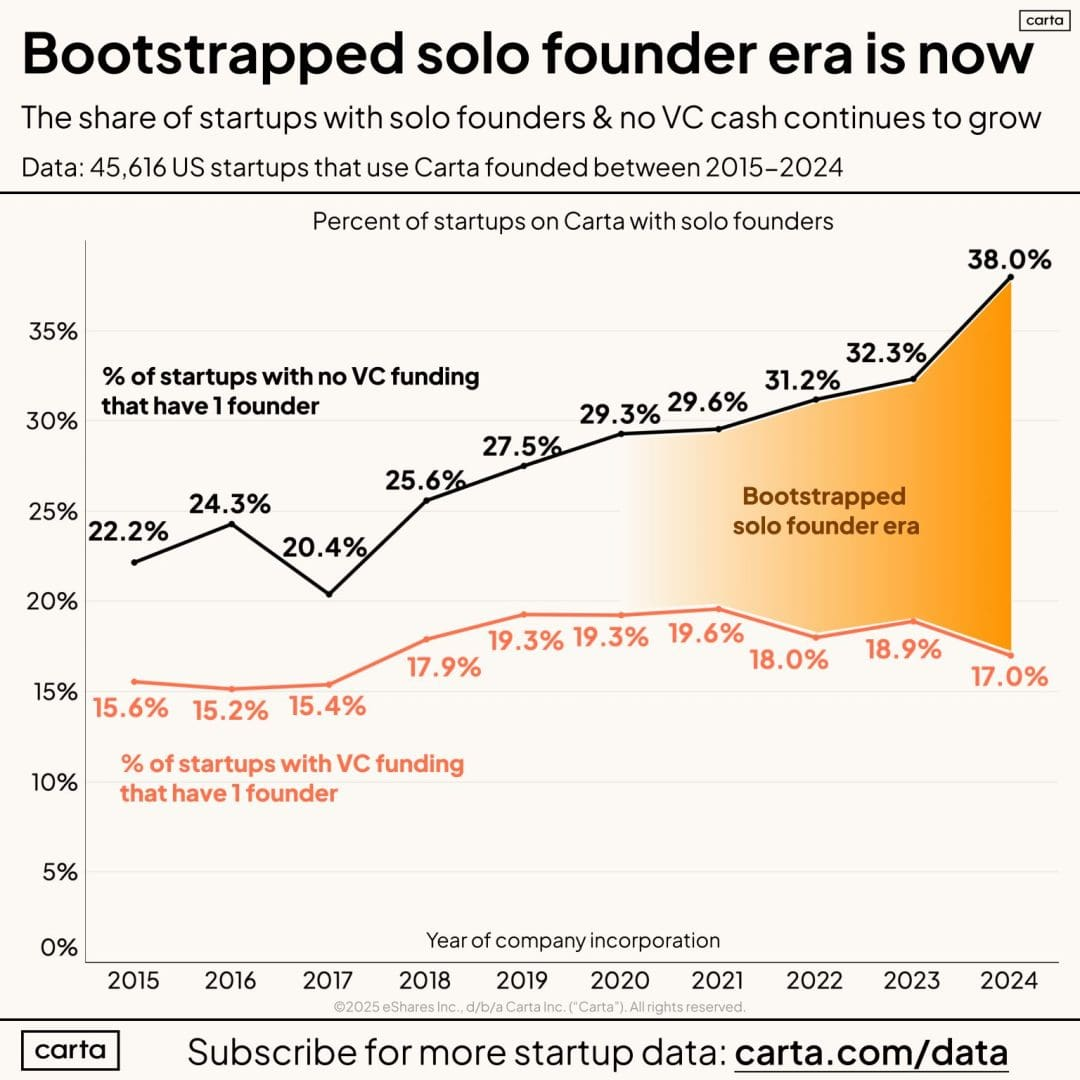
Base44 is the headline, but the base rate is the real story. According to Carta, the share of new US startups with a solo founder and no VC money has climbed steadily from 22.2% in 2015 to 38% in 2024. [2] More than a third of new bootstrapped companies are now one person and a stack of software.
You don't have to start a company to feel this. The same tools that let one person build a fundable product let a PM inside a 500-person company skip the three-week wait for a "rough version." Lenny's Newsletter surveyed 1,750 tech workers in late 2025 and found PMs are already using AI most to write PRDs (21.5%) and to create mockups and prototypes (19.8%) — and prototyping is the single most-wanted next use case, jumping to 44.4%. [3] Tools like Lovable and Cursor are now cracking the top seven tools PMs say they'd hate to lose. The PM toolkit has quietly grown a "build" tab.
Why founders are pulling ahead
Here's the part that should reframe how you think about the role. In that same survey, founders got more out of AI than any other job function — 49% said it saves them over six hours a week, 78% reported positive ROI, and 45% said the quality of their work was "much better." [3] Designers, by contrast, saw the least benefit.
The reason is instructive: founders use AI to think, not just to produce. Their top use cases were decision support, product ideation, and strategy — exactly the work a good PM is supposed to own. The builders winning right now aren't the ones who type the fastest. They're the ones using AI to compress the loop between "I have a hunch" and "I have evidence." [3]
What this means if you're a PM (and not planning to quit)
The builder lens isn't a demand that you go found a company. It's a demand that you stop outsourcing the first 80% of an idea. From my own seat building product in Prague — far from the Bay Area, where 23% of open PM roles now sit [4] — the most useful change of the last year has been deleting the gap between thought and artifact. A rough working prototype settles arguments that ten slides never could.
The AI model that you're using today is the worst AI model you will ever use for the rest of your life. — Kevin Weil, VP at OpenAI
The honest caveat — and it's a big one:
Survivorship bias is doing heavy lifting here. For every Base44, thousands of solo-built apps go nowhere. "Vibe-coded" prototypes are excellent for proving an idea and notoriously brittle in production. And Shlomo wasn't a first-timer — he'd already co-founded and scaled a 100-person, $125M-funded company before this. The tool floor has risen for everyone; the ceiling is still set by judgment, distribution, and persistence. Treat "one person can do it" as permission to start, not a promise it'll be easy.
So: being a product manager in 2026 increasingly means being a builder who happens to specialize in deciding what's worth building. The wait is gone. The excuse went with it.
Next in this series: the craft is shifting under our feet — which PM skills actually went up in value, and which ones AI just commoditized.
Comments
0Be the first to comment.